
Economics and Ecometry
Published in 2000, updated on February 28, 2022.
•••••••••••••••••••••••••••••••••••••••••••••••••••••••••••••••••••••••••••••••••••••••••••••••••••••••••••••••••••••••••••••••••••••••••••••••••••••••••••••••••••••••••••••••••••••••
Please note: Best
viewed at 1280 x 1024 resolution.
Texts in blue italics are "quotes."
Texts in blue underline are links.
Texts with N signify new or updated text.
Texts in black on white background are my texts, including My Fragments (MF#).
►You are allowed to copy from my texts or pictures, providing the copyright is properly attributed to: ©Ben Tamari
www.bentamari.com.
•••••••••••••••••••••••••••••••••••••••••••••••••••••••••••••••••••••••••••••••••••••••••••••••••••••••••••••••••••••••••••••••••••••••••••••••••••••••••••••••••••••••••••••••••••••••
Economics Quotes
Irving Fisher (1928). "The Money Illusion." Martino Publishing.
"Unstable money explains at least part of the secret of business fluctuations... ," p. 89.
My Fragments - From My Personal Point of View
For the complete list, please see Tamari.
MF7: Globalization + Computerization = Tsunamization. Added 9 October 2008.
MF11: Collectivization and privatization are crimes against humanity. Added 24 July 2010.
MF20: Words are clouds and mathematics is the rain. Added 12 March 2012.
MF22: When the money illusion stops, Gresham's Law start to operate. Added 28 July 2014.
Economics
The main conclusions in Ben Tamari's publications are:►The Neutrality of Money:
Money is not a neutral entity in the economic process, because it is simultaneously a measure and an input. Thus, there is an optimal quantity of money that should be 'employed' in any given country, and the Ecometry method may be used to determine that optimum quantity. This is a generalization of Keynes' theory.
►Inflation is a Symmetrical Phenomenon:
Inflation is a symmetrical phenomenon; both money and output, which are brought to the market and replace one another, have a part in its formation. Because of the relativity of the measure (money) and the entity to be measured (output), we tend to view inflation as a monetary phenomenon.
►Nominal Anchor:
The Nominal Anchor of setting the rate of printing to equal the rate of growth (m = q) is consistent with economic theory and empirics as represented here. This old-new rule enhances an economy's health, and moderates the adjustment processes and pressures in the rehabilitation of pathological economies.
►Conservation and the Symmetry Laws:
The formal structure satisfying the conditions of conservation and symmetry laws: p = m-o, where p = Inflation (the rate of change of pricing), m = Printing (the rate of change in money), and o = Growth (the rate of change in output). This is the Pricing Law or Symmetry Law, and the alternative and more generalized version of Samuelson's Conservation Law. As the old saying goes, "Inflation occurs when too much money is chasing too few goods."
►Keynes Space and Complex Numbers:
An autonomous economic system, i.e., a country, tends to be a conservative and symmetrical system in Keynes space [O,M], and can therefore be represented as a complex numbers system. This presentation makes it possible to aggregate or disaggregate the system at all levels, from the individual to the most general aggregate and vice versa.

Published by: Ecometry Ltd.
Publications by Ben Tamari:
Books
Ben Tamari (1990). "Foundations of Economics." Hebrew.

Abstract: This book proposes a new way to explain and forecast economic processes. We know that forecasting in a conservative system may be done well (just like in energy and weather systems, the more closed the system, the better the forecasting). An autonomous economic system (i.e., a country) is a conservative system in Keynes space, defined as an output-money space (i.e., a market).
Ben Tamari (1995). "Dynamic Economy." Hebrew.

Abstract: A conservative system in which rates are linearly related is a symmetric system. Symmetry dictates that the inflation rate equals the money-printing rate minus the growth rate. An empirical study of 45 countries between the years 1960 and 1993 verifies the principles of both conservation and symmetry. Tamari's theories enable good economic forecasting through formulating 'motion equations' (derived from the Lagrangian function) and their solutions (Lorentz transformations), based on the conservation and symmetry principles as described in his books.
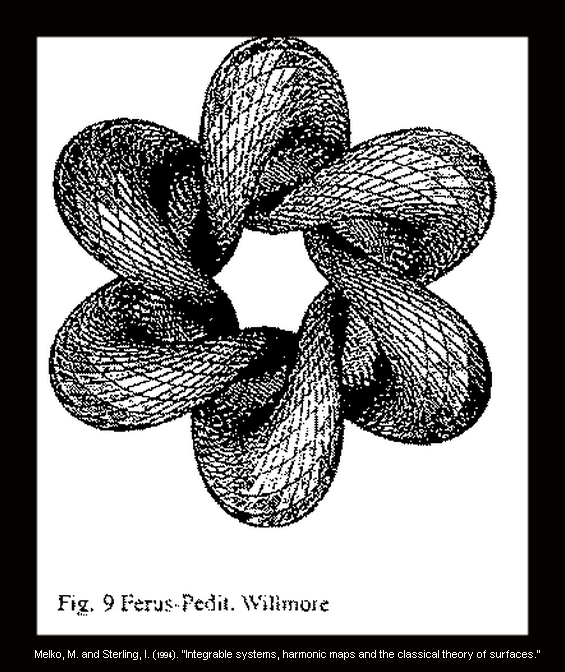
On 15 October 2014,
I learned about Dobriner / Willmore surfaces, which express mathematically what I had in
mind when writing the book. All the equilibrium points (where demand
equals supply over the course of time) are constrained in a geometric shape,
like in a pipe or torus, which expresses the invariance and conservation in nature
- and physics or economics as well.
You can't build a perpetum-mobile in physics and you can't create growth by
printing money. Added 12 October
2014.
Ben Tamari (1997). "Conservation
and Symmetry Laws and Stabilization Programs in Economics." English.
Abstract: An autonomous economic system, i.e., a country, tends
to be a conservative and a symmetrical system in Keynes space (Output, Money
and Time [Ot,
Mt ; t]), and can therefore be represented as a complex
numbers system. This presentation makes it possible to aggregate (or
disaggregate) the system at all levels, from the individual to the most general
aggregate (and vice versa). It also offers a simultaneous solution to the
problem of allocating and distributing useful resources in the market. Software
Ben Tamari (2005). "Eco
- Economic Simulator." Softwaree.
Abstract:
Eco - Economic Simulator software - an application of the Tamari attractor - enables the study of
a country's economy. The software performs a simulation of the country's economy: analysis, planning, prediction and comparison
with other nations' economies, based on data in International Financial Statistics (IMF) for the years 1960-2011 for 26
select countries. The simulator was designed for five purposes:
►To simulate a country's economy, for
which we need a three dimensional
space called the
Economic Cosmos (the Nest/Tamari space), or an OUTPUT-MONEY-PRICING [O,
M, P]
space. The Nest/Tamari space includes three two-dimensional subspaces: ►To compare the performance of
different countries' economies according to the same measure and data scale. ►To forecast
a country's economy. ►To investigate the possibility of increasing/decreasing the quantity of money per output. ►To practice the attractor tool, which is the
engine of dynamic systems in nature.
Here is my Exel
page EcoSite2013 [for those who young enough to take the mission ahead.]

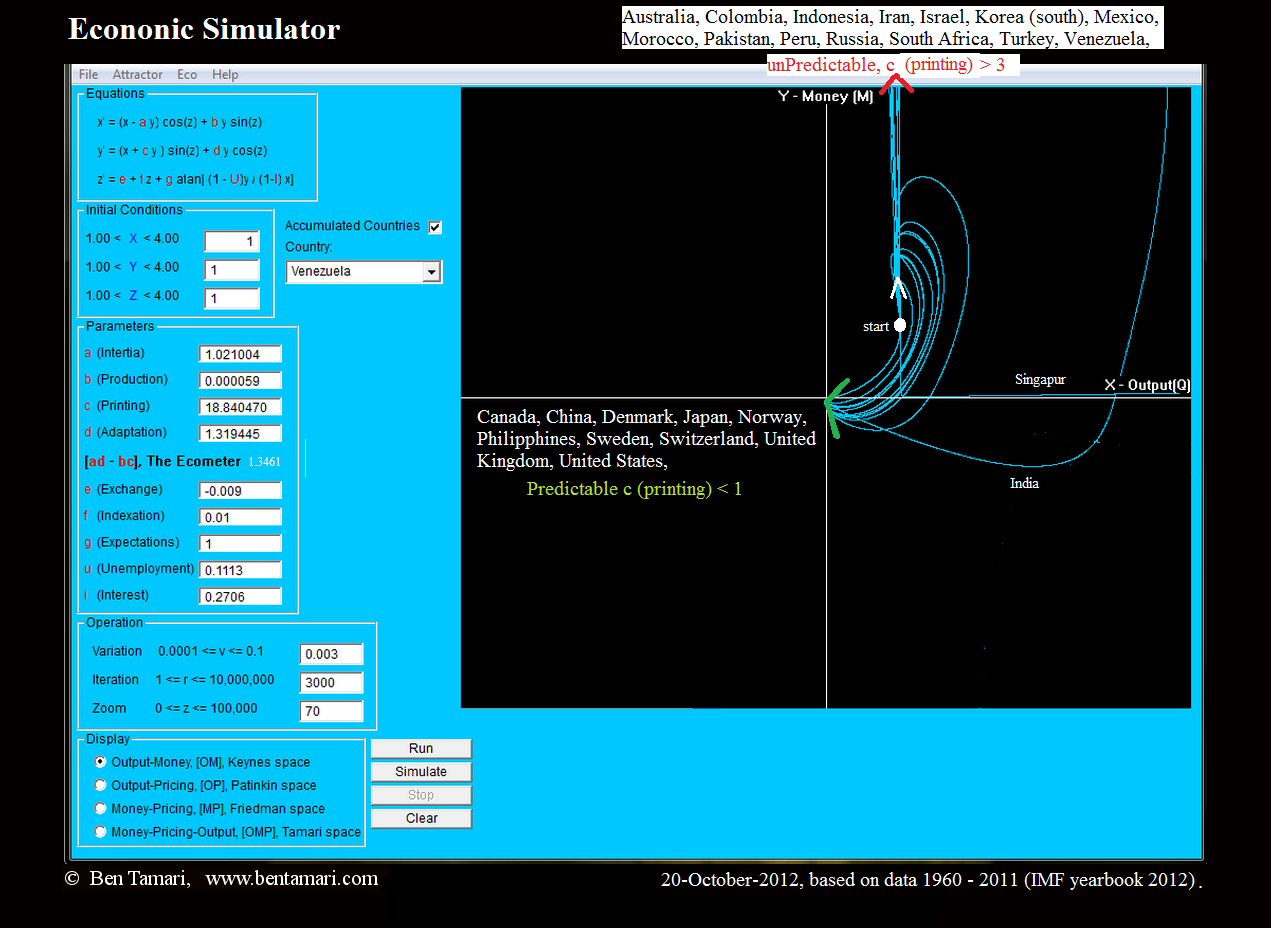
Output-Money - Keynes
space [O,
M]
Output-Pricing - Patinkin
space [O,
P]
Money-Pricing - Friedman space
[M,
P]
Published by "The Economic Quarterly," Israel.
Articles (English, *.PDF)
Ben Tamari (1981). "Cycles, Prices and Quantities in the Israel Housing Market - Cobweb Model." Updated March 2011.
Abstract: The housing sector in Israel: Israel's residential construction sector has always been a principal factor in the structure of business cycles in Israel, primarily as a result of waves of immigration. Increasing population, financing methods, higher income and individual investment needs all converged and came to be reflected on the demand side for housing. On the other hand, technology, private and public entrepreneurship, the housing inventory and workforce availability converged on the supply side. The position and direction of the housing sector in the business cycle can be identified by using a cobweb model.
Ben Tamari (1983). "Gresham's Law." Updated July 2021.
Abstract: The article examines the historical origins of Gresham’s Law,'Bad money drives out good money,' as well as how it has evolved on one hand, and its monetary significance on the other. In fact, different phrasings of this law have different meanings. According to Tamari, the problem is not what bad money does to good money, but rather the influence of the devaluation of the legal tender on the monetary aggregates.
Ben Tamari (1985). "Anatomy of a Tragedy." Updated July 2012.
Abstract: In 1914 Germany set out to correct the injustice it deemed had been perpetrated upon it inside its territorial area in Europe, and in its
colonial position outside Europe. It wished to express the military, economic
and cultural power that it had consolidated in the late 19th and early 20th
centuries. "Tension seethed between the veterans in the colonial realm –
Britain, France, Russia, Holland – and the hungry newcomers, such as Germany and
Italy," (Talmon, p. 488). The spirit of Bismarck haunted Germany – unification (led
by Prussia), statehood and militarism. "Fifty years were spent in the process of
making Europe explosive. Five days were enough to detonate it," (Liddel Hart,
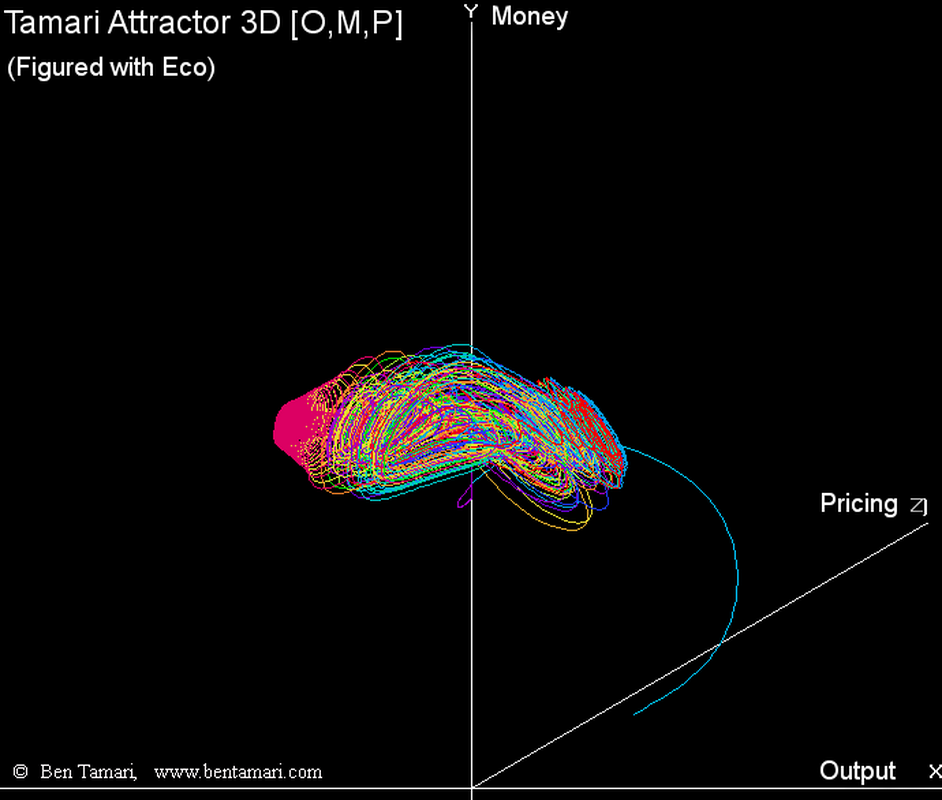
p. 17). Ben Tamari (2014). "Economic/Tamari Attractor." Abstract:
The Economic/Tamari Attractor, named for Ben Tamari,
is a three dimensional
attractor
evolving from the dynamic system associated with the theory of countries'
economics. This dynamic system is a set of partial differential equations which,
according to the theory of economics developed by Tamari, control the economics of a
country. The main point of this economic theory is that the relation
between the quantity of money to the country's output is what
governs the country’s economic situation and outcome.
Articles (Hebrew, *.PDF) Ben Tamari (1981). "Cycles,
Prices and Quantities in the Israel Housing Market - Cobweb Model."
Updated
March 2011.
--------------- (1983). "Gresham's
Law" Updated July 2021. --------------- (1985). "Anatomy
of a Tragedy." Updated July 2012. --------------- (1986). "Theoretical
and Empirical Inflation." --------------- (1990). "Why
Is There No Growth in Israel?" --------------- (1993). "Chaos
and Stocks - Review." Updated June 2011. --------------- (1994). "Chaos
in Economics." Surveys (Hebrew, *.PDF) Ben Tamari (1981). "Patinkin
and the Chicago School." ---------------- (1983). "Money
and Freedom." ---------------- (1984). "Is
Everything Psychology?" ---------------- (1984). "All
That You Wanted to Say, But Don't Dare." ---------------- (1985). "Security
and Economics in Israel." ---------------- (1987). "Success
That Is a Failure." ---------------- (1989). "Keynes
and Batra." Under a pseudonym with a political economic flavor (Hebrew, *.PDF). Ori Benjamin (1981). "We Don't Want
to Go On Sleeping but to Have Fun" ---------------- (1981). "The Cashier Is Open
and the Hand Is Writing" ---------------- (1982). "Bubbles: New Innovations
in Economics" ---------------- (1984). "Facing
the Reality" ---------------- (1989).
"Three Mistakes"
Introduction to Ecometry (Eco-nomics -
Geo-metry) What can be done to bring about the recovery of an autonomous
economic system (defined as such if it issues its own
currency) that has gone wrong: decelerating growth, rising unemployment and
prices, deficits and debts - both domestic and foreign, and declining exchange
rates? An economic system does not fail all at once; the process is
protracted, sometimes lasting two or more generations (as in the former Soviet
Union). The source of failure is generally a monetary imbalance, relative to the
output, which at first produces desirable results, so that the imbalance is
maintained, ultimately becoming destructive (somewhat like "pep pills"). By now, sufficient knowledge and experience have been
accumulated, on both the theoretical and empirical planes, to permit reforms to be
introduced into such ailing economic systems. The obstacles to successful
reforms are generally political. Specifically, powerful pressure groups, attempting to
protect themselves against what they believe would be the recovery process's harmful effects on them, and they hinder implementation of the measures necessary for
economic recovery. One commonly proposed measure for the stabilization of an ailing
economic system during planned reforms is what is known today as a 'Nominal
Anchor,' the main component of which is the exogenous fixation of the system's rate
of exchange. My thesis in this paper is that the "Nominal Anchor," may be replaced
by a preferable, dynamic operating rule. This rule, the 'Symmetry Law,'
when
applied to an economic system, will steer the system asymptotically to an
optimal state. As a result, the system will not experience unnecessary
shocks after the stage of stabilization and curbing (e.g., Israel in 1985;
Mexico in 1988). However, in order for this to happen, the Symmetry Law requires
more political resolve from the system than the "Nominal Anchor."
Ecoland - The Economic Cosmos - Tamari Space "When you discover mathematical structures that you believe correspond to the world around you, you feel you are seeing something mystical, something profound," he said. "You are communicating with the universe, seeing beautiful and deep structures and
patterns that no one without your training can see."
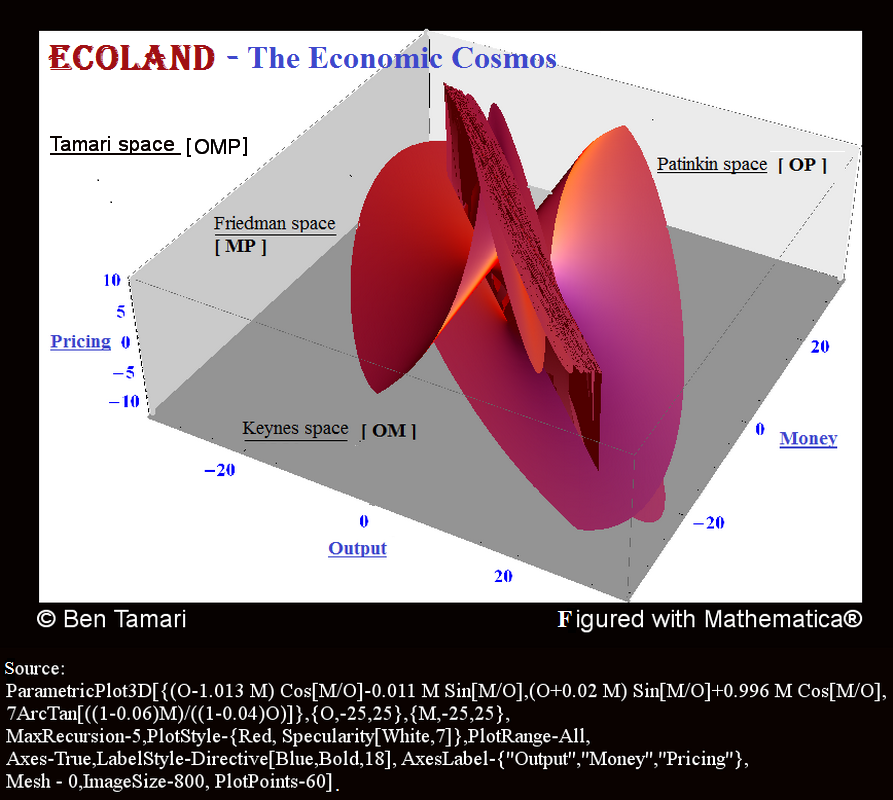
http://currents.ucsc.edu/03-04/08-04/tromba.html Ecoland, or the Economic Cosmos, or Tamari space, is a three-dimensional space:
Output, Money and Pricing [O, M, P]
governed by three equations; the space has three sub-dimensional spaces:
Keynes space [OM], Friedman space [MP], and Patinkin space
[OP].
The Tamari attractor is the trajectory solution of the three equations, which 'sail' in Tamari space:
The economic simulator equations X' = (X
-
aY)cos(Z)
-
bYsin(Z), X
≡
O, output
Conservative/Cremona Y' = (X
+
cY)sin(Z)
+
dYcos(Z)
, Y ≡ M, money
Thirty-four years after that unfortunate, fateful event (and perhaps because of
it), the State of Israel was established. Over its first decade the state forged
and strengthened itself, under the prevailing spirit of Ben-Gurion – for unity
(led by the Jews from Eastern Europe), statehood and "securitism." In 1982
Israel set out to correct the injustice it deemed had been perpetrated upon it
from its northern border, and exercised its military and economic power in order
to dictate the terms of peace to its neighbor in the north, establish its
territorial area (about a third of which was under dispute domestically, and
held no agreement from without), and "erase" the traumas of the previous war.
------------------------------------------------------------------------------------------------------------------
Z' = e + fZ + garctan[(1 - u)Y / (1 - i)X]Z ≡ P, pricing version feedback equation
Z' = e + fZ + garctan[(1 - u) / (1 - i)XY]Z ≡ W, wealth version feedback equation
Source: Ben Tamari (1997). "Conservation and Symmetry Laws and Stabilization Programs in Economics," p. 17.
Economic Equilibrium Points in time:

Analysis and study of the variables and invariables of each country show its position in the Nest. The rule according to which the economy behaves is that the deeper a country is located towards the center of the Nest (the green area), the better its position, and the more it moves towards the periphery (the red area), the worse its position.
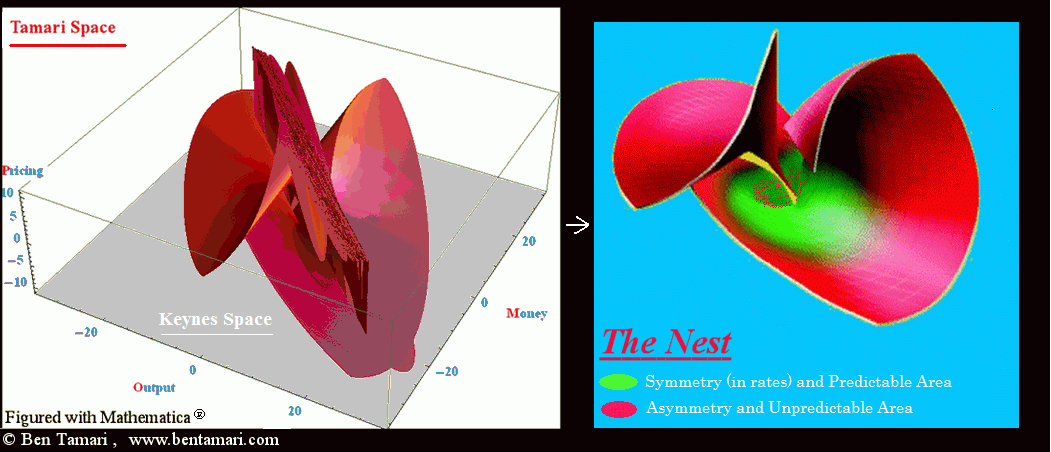
Eco2 software enables studying a country's economy. The software simulates the national economy: analysis, planning, prediction and comparison to other states' economies, according to the data in International Financial Statistics (IMF) for the years 1960-2007 (see Simulator page).
Ecometer
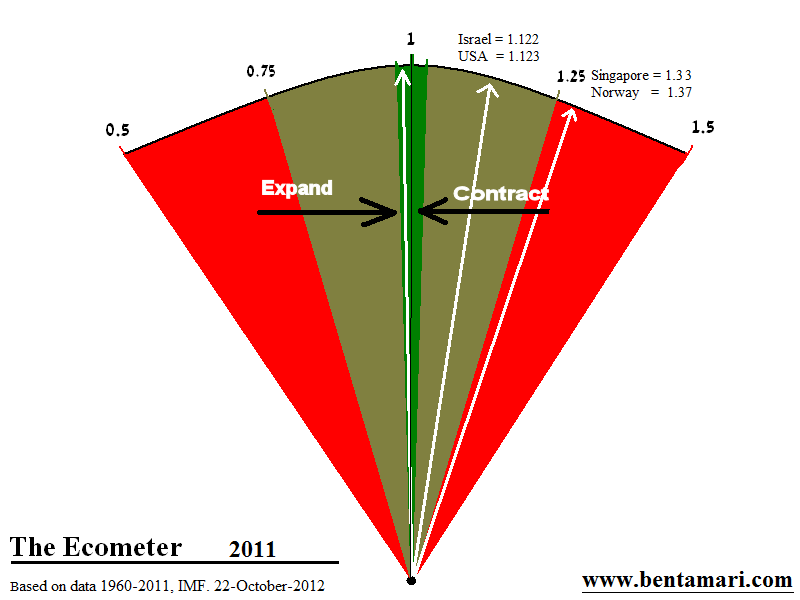
The Ecometer measures the conservation of a country's economic system, just like a thermometer measures body heat. It is like an X-ray showing that country's real economic situation.Conservation means the optimal ratio between money and output (with M/O around 0.33...; perhaps the "Golden (or Wurf) Rule" is the underlying explanation [Petukhov, p. 533 (1989)]). The Ecometer is the (indirect) indicator of that ratio. If the country is in a less than optimal ratio, its economy is heading for a depression; if it is in a greater than optimal ratio, the economy is "flooded" with money and must undergo a contracting and drying process.
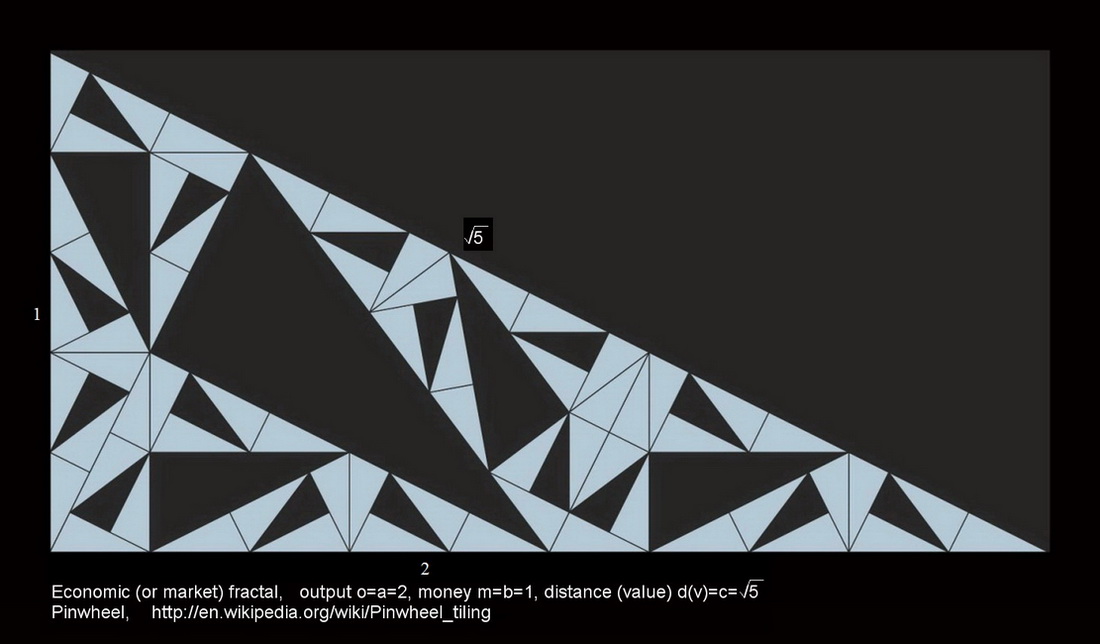
The economic fractal or the market fractal (the pinwheel): Added 16 April 2015.
The dynamic situation in select countries: Israel, USA, Singapore and Norway (2011):
Note 1, 25 December 2007 Note on interest rates
See: Paul A. Samuelson (19 November 2007) "Balancing Market Freedoms," International Herald Tribune.
"It used to be enough for a central bank to "lean against the wind." That means lower interest rates when unemployment is too high and when deflation threatens. And when business growth is too brisk, central banks are supposed to raise their interest rates to dampen growth and to forestall price-level inflation that threatens to exceed 2 percent per year. Today, central bankers and U.S. Treasury cabinet officers cannot know [my underline, B.T.] whether current interest rates are too high or too low. This is surprising, but true. ... "
"What the world does not need now is tolerance for any persistent weakness in global Main Street growth. It is better when physicians worry too much about a patient's health than when they worry too little."
I devised the Ecometer to calculate optimum money growth and interest rates for different situations, both simple and complex. This is just the beginning, it might forecast a heat wave in Alaska and snow in the Sahara, like in the early days of weather forecasting. But I am convinced that after enough years of observation, (at least 70, from 1960 to 2030), and an adjustment process, the analysis and forecasting will be good enough to navigate the economy of a country fairly accurately.
What the world does need now is a persistent reduction in global Main Street growth, due to pollution, the shortage of resources, and unfair distribution of wealth among nations. We, as a whole, are growing too much. We must slow down Main Street growth and speed up growth in the peripheries.
Note 2, 15 April 2009 Note on the economic crisis. Updated 10 October 2014.
The economic crisis that began in 2008-09 consists of two components or layers: a shortage of resources on the planet relative to demand, and an excess of expanding monetary policy for policy for the dollar, which is the legal international currency. Old trees must die, and Obama was wrong twice, in his support of the dinosaurs, and in his infusing more money into the economy.
The symptoms of this crisis have been the opposite of those in the crisis of 1929-1936. Since the monetary system shrank back then, it was necessary to expand it. In the modern crisis, the monetary system has not shrunk but the velocity of money has declined. Therefore, the US government should take measures to help raise the velocity of money (by creating demand for new technologies instead of old ones). Socialism for the rich and capitalism for everyone else is not a good idea or answer.
Zero interest rates (or close to it) are a huge mistake, which is also why Japan couldn't surmount the crisis, because there was too much money and credit in the economy. A surplus of money (and low interest rates) is as destructive as a shortage of it. Money is more important than we know. It is not only a means of measure, transaction and store value but also a coordinator. Every economic unit navigates itself in “space-time and mass-energy” in the universe, according to the adage 'money talks,' or the "invisible hand" in the terminology of Adam Smith. We usually know what is profitable for us, on condition that money (relative to output) is at an optimum level, and therefore there is no inflation and no "money illusion."
According to Gresham’s Law; "Bad money drives out good from the markets"; and the good drives out the bad from the pockets. The dollar, after a long history as good money, started to be bad money. Therefore, the real balance effect started to work, and dollars came out of pockets, creating the last bubble in the real estate markets. Two other such cases, are described in my article “Anatomy of a Tragedy” (1985): Germany in the '30s and Israel in the '80s. Since an optimal quantity of money (relative to output) is a wise policy, printing money must be taken out of the politicians' hands.
An economic system, like a weather system, can be forecasted. We are just at the beginning; the formulas are still immature and the statistical data are not yet sufficiently credible or quantitative.
N Note 3, 28 February 2022 Note on the Value.
Ünsal, Ö.
(2022) "Value order in disorder", International Journal of Dynamics and Control."Value is a non-algorithmic cognitive state that cannot be directly approached and reliably measured based on price, cost, and income (PCI)." ...
Tamari, B (1990). "Foundations of Economics.[the PDF, p. 25]" Hebrew. [the book p. 39] Value is: V = (Q2 - M2)1/2 , Pythagoras number.
What Ünsal called "Value" I called "Utility" - The invisible hand.
Books
Ahamed, L. (2009). "Lords of Finance: The Bankers Who Broke the World." The Penguin Press.Brock, Hsieh and LeBaron (1991). "Nonlinear Dynamics, Chaos, and Instability, Statistical Theory and Economic Evidence." MIT Press.
Burley, P. and Foster, J. (Eds.) (1994). "Economics and Thermodynamics: New Perspectives on Economic Analysis." Kluwer AP.
Chiang, A.C. (1992). "Elements of Dynamic Optimization." McGraw-Hill.
De Soto, J. H. (2009). "Money, Bank Credit, and Economic Cycles" 2nd ed. Ludwig von Mises Institute.
Fisher, I. (1928). "The Money Illusion." Martino Publishing.
Fisher, I. (1933). "The Debt-Deflation Theory of Great Depressions." Michael Schemmann, ThaiSunset Pub.
Fisher, I. (1936). "100% Money and the Public Debt." Michael Schemmann, ThaiSunset Pub.
Johansen, L. (1977). "Lectures on Macroeconomic Planning." North-Holland.
Kamien and Schwartz (1981) "Dynamic Optimization: The Calculus of Variations and Optimal Control in Economics and Management." North Holland.
Keynes, M.J. (1936). "The General Theory of Employment Interest and Money." MacMillan.
Lorenz, H.W. (1993). "Nonlinear Dynamical Economics and Chaotic Motion." Springer-Verlag.
Mandelbrot and Hudson (2004). "The (Mis)Behavior of Markets." Basic Books.
Mantegna and Stanley (2000). "An Introduction to Econophysics: Correlations and Complexity in Finance." Cambridge.
Medio, A., with Gallo, G. (1992). "Chaotic Dynamics: Theory and Applications to Economics." Cambridge UP.
Patinkin, D. (1969). "Money, Interest, and Prices." 2nd ed. Harper & Row.
Peters, E.E. (1991). "Chaos and Order in the Capital Markets." John Wiley & Sons, Inc.
Petukhov, S.V. (1989). "Non-Euclidean Geometries and Algorithms of Living
Bodies." In "Symmetry 2: Unifying Human Understanding."
Hargittai, I., Ed. Pergamon Press.
Puu, T. (1991). "Nonlinear Economic Dynamics." 2nd ed. Springer-Verlag.
Puu, T. (2003). "Attractors, Bifurcations, & Chaos; Nonlinear Phenomena in Economics." 2nd ed. Springer.
Puu, T. and Sushko, I., (Eds.) (2006). "Business Cycle Dynamics." Springer.
Reinhart, C.M. and Rogoff, K.S. (2009). "This Time Is Different, Eight Centuries of Financial Folly." Princeton University Press.
Samuelson, P.A. (1947, 1983 enlarged edition). “Foundations of Economic Analysis.” Harvard UP.
Sargent, T.J. (1987). "Dynamic Macroeconomic Theory." Harvard UP.
Sato and Ramachandran (1990). "Conservation Laws and Symmetry: Applications to Economics and Finance." Kluwer AP.
Stokey and Lucas with Prescott (1989). "Recursive Methods in Economic Dynamics." Harvard UP.
Svetunkov S. (2012). "Complex-Valued Modeling in Economics and Finance." Springer.
Takayama, A. (1985). "Mathematical Economics." 2nd ed. Cambridge.
Tvede, L. (2006). "Business Cycles." 3rd ed. John Wiley & Sons, Ltd.
Zhang, Wei-Bin (2005). "Differential Equations, Bifurcations, and Chaos in Economics." World Scientific.
Links
http://en.wikipedia.org/wiki/Symmetry
http://ideas.repec.org/p/wpa/wuwpfi/9411001.html
