The Algebra of Metaphors
Published in 2000; updated on March 1, 2015
•••••••••••••••••••••••••••••••••••••••••••••••••••••••••••••••••••••••••••••••••••••••••••••••••••••••••••••••••••••••••••••••••••••••••••••••••••••••••••••••••••••••••••••••••••••••••
Please note: Best
viewed at 1280 x 1024 resolution.
Texts in blue italics are "quotes."
Texts in blue underline are links.
Texts with yellow background and
N or
U signify new or updated text.
Texts in black on white background are my texts, including My Fragments (MF#).
►You are allowed to copy from my texts or pictures, providing the copyright is properly attributed to: ©Ben Tamari
www.bentamari.com.
•••••••••••••••••••••••••••••••••••••••••••••••••••••••••••••••••••••••••••••••••••••••••••••••••••••••••••••••••••••••••••••••••••••••••••••••••••••••••••••••••••••••••••••••••••••••••
This page is dedicated to my friend Jacob Lavie יעקב לביא , who died of cancer on 20 March 2004 at the age of 75.
He was a Socratic type.

Metaphor Quotes
José O. Gasset (1925). "The Dehumanization of Art." Trans. by Helene Weyl, 2nd ed., Princeton. p. 32, 33, respectively. Added 10 October 2010.
"Poetry has become the higher algebra of metaphors."
"The metaphor is perhaps one of man's most fruitful potentialities. Its efficacy verges on magic, and it seems a tool for creation which God forgot inside one of His creature when He made him."
●
Ernst Mach (1943). "Popular Scientific Lectures." Trans. by McCormack, 5th ed. The Open Court Pub, p. 275.
"The movement of our thoughts obeys the law of association."
●
Carl G. Jung (1961). "Memories, Dreams, Reflections." Vintage Books (April 1989) New York, p. 302.
"The unconscious helps by communicating things to us, or making figurative allusions."
●
Rudy Rucker (1987). "Mind Tools: The Five Levels of Mathematical Reality." Houghton Mifflin Company, Boston, p. 247.
" Church's theorem is a metaphor for the fact that no simple test can give Yes or No answers for important questions."
" Godel's theorem is a metaphor for the fact that no logical program can hope, even in the limit, to answer all the questions."
●
Montague Ullman (October 1992). In Steven M. Rosen "Science, Paradox, and the Mobius Principle." State University of New York Press, Foreword, p. xi.
"The poet sends her poem out
into the world.
The dreamer is communicating to himself.
Both use the medium of metaphor,
the poet by rearranging words,
the dreamer by rearranging images."
●
Stephen Jay Gould (1996). "Full House." Harmony Books, New York, p. 7.
"We reveal ourselves in the metaphors we choose for depicting the cosmos in miniature."
●
Jorge Luis Borges (2000). "This Craft of Verse." p. 33.
"Now we are led to the two obvious and major conclusions of this lecture. The first is, of course, that though there are hundreds and indeed thousands of metaphors to be found, they may all be traced back to a few simple patterns. But this need not trouble us, since each metaphor is different: every time the pattern is used, the variations are different."
●
John, L. Casti and Werner DePauli (2000). "Gödel: A Life of Logic." Basic Books, p. 122.
"...a material object - the human brain - gives rise somehow to the mind, the mind itself seems to have no material composition. Rather, it appears to consist solely of patterns of information existing in some realm beyond ordinary space and time."
●
Connes, Alain in Karl Sabbagh (2002). "The Riemann Hypothesis." Farrar, Straus and Giroux, p. 242.
"Geometrical perception, which
is extremely rich and elaborate, is directly tied up with the visual areas of
the brain.
Using these areas you can immediately contemplate a picture and perceive the
beauty of it."
●
Marcel Danesi (2004). "Poetic Logic: The Role of Metaphor in Thought, Language, and Culture." Atwood Pub., p. 55, 125 respectively.
"It is impossible to study the mind without recourse to metaphor."
"Metaphor is the default form of thought, providing many angles from which to literally "see" the world."
●
Temple Grandin (2006). "Thinking in Pictures, Expanded Edition: My Life with Autism." Vintage Press.
"I THINK IN PICTURES. Words are like a second language to me."
●
Freeman Dyson (2007). "Mathematics as Metaphor: Selected Essays of Yuri I. Manin." American Mathematical Society, Foreword p. vii.
"Coordinates, fluxions,
symbolic logic and Riemann surfaces are all metaphors,
extending the meanings of words from familiar to unfamiliar contexts."
●
Terry Marks-Tarlow (2008). "Psyche's Veil: Psychotherapy, Fractals and Complexity." Routledge, p. 92.
"The art and science of
psychotherapy merge within its metaphors ...
Metaphor is a primary
cognitive tool by which we make sense of the world."
My Fragments - From My Personal Point of View
For the complete list, please see Tamari.
MF2 : The Pythagorean Theorem: a2 + b2
= c2 is the seed ; Einstein's
Formula: E = MC2 is the tree.
In
the spirit of
Friedrichs (1965). "From Pythagoras to Einstein," MAA. Added 10
July 2000.
MF3: Fractalization of the Language I. Added 21 April 2002.
•
•
•
A word is worth a thousand ...?
"A picture is worth a thousand words," as the old saying goes,

but sometimes:
One good sentence is worth a thousand
pictures.
For example:
"A picture is worth a thousand words"
(like a Mobius strip).
A metaphor is worth a thousand pictures.
An allegory is worth a thousand metaphors.
A ? is worth a thousand allegories.
•
•
•
MF10: Fractalization of the Language II. Added 15 November 2009.
"Between any two 'points' in a
set of points"
or numbers, words, sentences, paragraphs, thoughts, etc.,
"we can put another point"
or numbers, words, sentences, paragraphs, thoughts, etc.,
and if the set is not big enough, we can add another 'point.'
Georg Cantor and Kurt Gödel used this to prove their theorems. Of course, the trick is not just to add another 'point,' numbers, words, sentences, paragraphs, thoughts, etc., but to find a new one.
Wislawa Szymborska (2005) "Colon": "The nightmare of the poet" (trans. by Deena Land, 15 July 2010)
"An allocated number of words. Never a needless one.
Meaning - no poetry.
And no philosophy and no religion."
MF8: A metaphor is a bridge
from the known to the unknown. In the spirit of Ariston.
Added 7 March 2009.
Or more precisely :
MF12: A metaphor is a harpoon thrown from the known
into the unknown.
Added 7 August 2010.
MF17: Our words are the clothes for our soul , and our clothes are the words of our body. Added 10 August 2010.
MF18: A good metaphor is the cornerstone of a new theory. Added 20 August 2010.
MF21: Give me a nail and I will hang my God. In the spirit of Archimedes. Added 1 August 2013.
U Metaphors - Algebra Rules (MAR#):
MAR-1. A new idea, the result of the combination of two (or
three) metaphors, pictures or tools, must give birth to yet a new insight,
or solve a certain problem (e.g., Columbus).
MAR-2. Each metaphor must come from a different discipline or technology (e.g., Kepler, Picasso).
MAR-3. At least one of the drawings must be an original work of the ‘inventor’ (e.g., Sturgeon, Volta).
MAR-4. It is not mandatory to be the originator, but one must be the first to analyze (e.g., Marshall).
MAR-5. Simply describing a dream is not sufficient by itself (e.g., the snake of Kekule).
Metaphor's Algebra (MA#)
MA1: Tamari - The Cylinder and the Stock Market. Added January 2000.
MA2: Columbus - The Way to India. Added June 2000.
MA3: Kepler - The Distances Between the Planets in the Solar System. Added December 2000.
MA4: Sturgeon - The ElectroMagnet device. Added April 2004.
MA5: Mandelbrot - Mandelbrot Set. Added May 2006.
MA6: Marshall - Economic Equilibrium. Added April 2007.
MA7: Copernicus - The Universe. Added December 2009.
MA8: Volta - The Battery. Added June 2012.
MA9: N Picasso - Cubism. Added June 2014.

* The metaphors are arranged chronologically according to the
originators' births, since every metaphor relies on all the
metaphors / schemes / images / pictures that preceded it, regardless of the area of science,
culture and
art.
●
MA2: Columbus - The Way to India. Added June 2000.

Christopher Columbus (1451-1506) In order to achieve his goal, Columbus made several assumptions: The world is round (a theory that was already well known before Columbus’ time); it is only 2,300 miles in circumference; and therefore, to reach Cathay, he needed no more than two months, which in those days was the maximum time a ship could be at sea without putting into port. The question was how to get the wind at his back. As a sailor who traveled between Spain and Africa, he noticed that the wind in Spain comes from the west (blows eastward from the sea), and the wind on the coast of Africa blows to the sea (westward).
To persuade the committee to allow him to make his voyage, he depicted the earth as pear-shaped. The direction of the wind was Columbus’s great secret: From the African coast to the coast of India (which turned out to be America), the wind blows westward. From the Indian (American) coast to the European coast, the wind blows eastward. Columbus began his first voyage in the Canary Islands and returned via the Azores.


The Earth ● Winds ● Columbus' first voyage, Morison (1942), p. 222.
Morison (1942). "Admiral of the Ocean Sea." Little Brown & Co., Boston.
MA7: Copernicus - The Universe. Added December 2009.

Nicolaus Copernicus (1473-1543). Aristotle supposed that the earth stood motionless at the center of the universe. Aristotle's cosmology and Christian theology together were accepted as the correct picture of the universe. Observations made after Aristotle's time were not compatible with this cosmology, in which the planets, the sun and the moon were thought to move in perfect circles around the earth at a constant speed. Sometimes the planets moved too fast or too slow, and sometimes they stopped or moved backward. After a long process of corrections, Aristotle's cosmology gave way to Ptolemy's cosmology, which included different centers for the movement of the planets. Each planet moved in an epicycle around a point on its own sphere, and the sun's orbit was at an angle to the orbits of the other planets. Copernicus changed Ptolemy's cosmology to fit observations with geometric considerations, mainly by reversing the perceptions of the earth's and the sun's positions. Now the sun was in the center and fixed, and the earth was in orbit, moving like the other planets.
Copernicus created the new cosmology by combining two disciplines - Cosmology and Geometry (mathematics in the terminology of his time), or, in his words:
"We find, then, in this arrangement the marvelous symmetry of the universe, and a sure linking together in harmony of the motion and size of the spheres, such as could be perceived in no other way." Copernicus, p. 50.
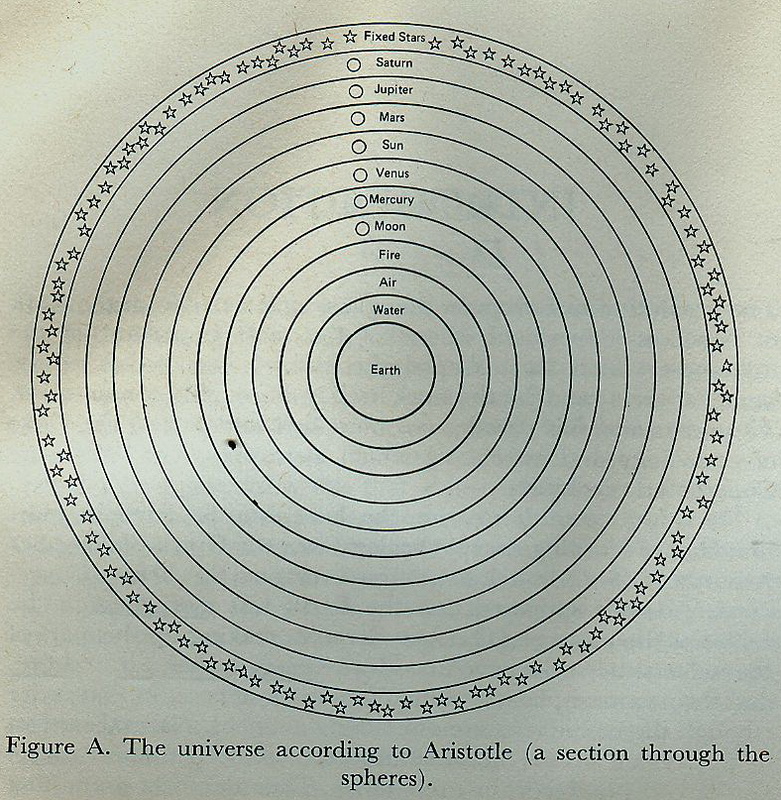


Copernicus (1976). "Copernicus: On the Revolutions of the Heavenly Spheres." Trans. by A.M. Duncan. David Charles.
http://www.webexhibits.org/calendars/year-text-Copernicus.html
MA3: Kepler - The Distances Between the Planets in the Solar System. Added December 2000.

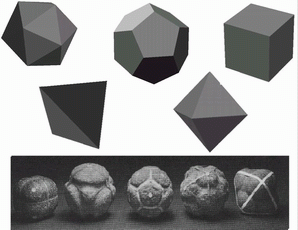
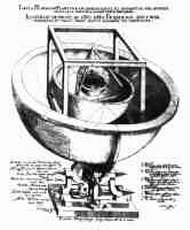
Johannes Kepler (1571-1630). Building upon the theories of Copernicus, Kepler envisioned the planets arranged around the sun as platonic solids (polyhedrons), one inside the other, in a three-dimensional universe. His great achievement was the shift from Copernicus’s two-dimensional map to three dimensions. The distances between the moving planets could be estimated by using platonic solids nested one inside the other as a starting point.
The heavens as a disk, as envisioned by Copernicus
● The five platonic solids ● The heavens as
envisioned by Kepler.
http://en.wikipedia.org/wiki/Johannes_Kepler
http://es.rice.edu/ES/humsoc/Galileo/People/kepler.html
http://antwrp.gsfc.nasa.gov/apod/ap960831.html
MA8: Volta - The Battery.
Added June 2012.
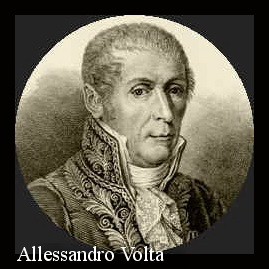
Allessandro Volta (1745-1827). Galvani's 'animal electricity' is the
result of contact between two different metals in a conductive environment. In
1800 he
announced a new electrical device - the Voltaic Pile - and described
it as an 'electric organ,' which is like the torpedo fish. It was the first direct current battery. "I have the pleasure of sending you some striking results at which I have arrived
in pursuing my experiments on the electricity produced by the simple mutual
contact of different metals. The chief result is the construction of apparatus
having the properties (such as ability to give shocks) of Leyden jars which
operate continuously, or whose charge is restored automatically after each
discharge. The apparatus of which I speak, and which doubtless will astonish
you, is nothing but the assembly of a number of good conductors of different
kinds, arranged in a certain manner, 30, 40, 60 pieces, or more, of copper or
silver, each placed next to a piece of tin or, better, zinc, and an equal number
of layers of water, or some other conducting liquid such as salt water, or
pieces of leather or card soaked in these liquids, are placed between each pair
of different metals. Behold, this is all that makes up my novel instrument,
which imitates, as I have said, the effects of a Leyden jar."
http://www.electric-history.com/~zero/004-Battery.htm
Frog legs (Galvani) + Torpedo fish (Volta) ● Volta
torpedo fish pattern - the artificial one ●
The Voltaic Pile - Battery
http://en.wikipedia.org/wiki/Alessandro_Volta
http://electrochem.cwru.edu/encycl/art-v01-volta.htm
http://www.sparkmuseum.com/BOOK_VOLTA.HTM
http://www.thocp.net/biographies/volta_alessandro.htm
http://www.wellnesselectrotherapy.com/electrotherapy_history_galvani_volta.html
MA4: Sturgeon - The ElectroMagnet device. Added April 2004.
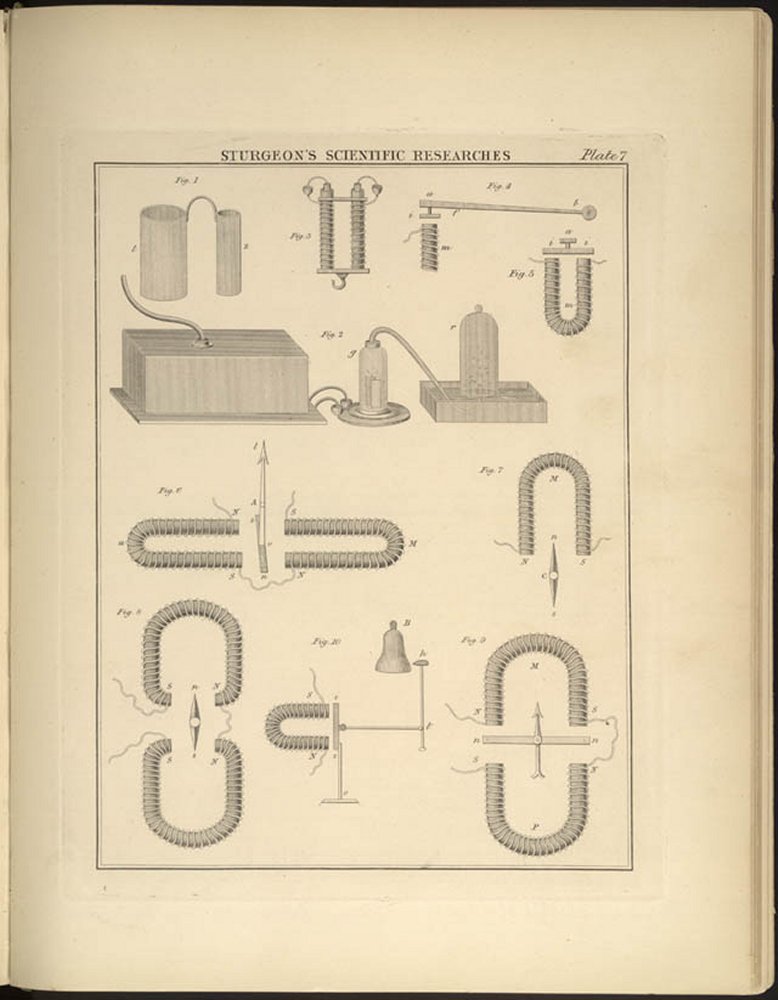
William Sturgeon (1783-1850). William Sturgeon was an English
electrical engineer. In 1825 he built the first practical electromagnet,
which led to the invention of the telegraph, the electric motor, and
numerous other devices basic to modern technology.
http://chem.ch.huji.ac.il/~eugeniik/history/sturgeon.html
http://inventors.about.com/library/inventors/blelectromagnet.htm
http://physics.kenyon.edu/EarlyApparatus/Electricity/Electromagnet/Electromagnet.html
http://www.sparkmuseum.com/MAGNET.HTM
MA6: Marshall - Economic Equilibrium.
Added April 2007.
Alfred Marshall
(1842-1924).
Fleeming Jenkin (1833-1885) was
probably the first to introduce demand
and supply together in one diagram. But "It
was left to Marshall to synthesize for general use the ideas of Jevons and
others, respecting demand, with those of Ricardo and Johan Stuart Mill,
on cost of production and supply, giving to the English-speaking world a
broader foundation for value theory than had been furnished by either of
antecedent schools."
Edmund Whittaker (1940). "A History of Economic Ideas," Longmans NY, p.
453. (My underline, B.T.). Marshall (1890). "Principles of Economics."
8th ed. (1949).
MacMillan, p. 346, n. 1. "To represent the equilibrium
of demand and supply geometrically we may draw the demand and supply curves
together as in: Fig. 19."
Demand, p. 96. ●
Supply, p. 344. ●
Demand and Supply together, p. 346.
http://www.econlib.org/library/Enc/bios/Marshall.html
* This Marshall metaphor is dedicated to the memory of
Don Patinkin.
MA9: N Pablo Picasso - Cubism.
Added June 2014.
Pablo Picasso (1881-1973). In 1904, the fourth
dimension, representing time, movement and evolution, became a 'hot' subject;
everybody was talking about it, including Picasso and his friends. Ever since the
development of photography, which made a very good 'copy' of life, nature
and portraits, artists had been seeking to express themselves (relative to nature
and people) in a more individual way. Picasso's statements that “I
paint what I think and not what I see” and “Painting
is a thing of intelligence” are apt expressions of that.
Maurice Princet brought the "




Pablo Picasso on Cubism:
"The fact that for a long time Cubism has not been understood and that even today there are people who cannot see anything in it means nothing. I do not read English, an English book is a blank book to me. This does not mean that the English language does not exist. Why should I blame anyone but myself if I cannot understand what I know nothing about?"
"When we discovered Cubism, we did not have the aim of discovering Cubism. We only wanted to express what was in us."
"The goal I proposed myself in making cubism? To paint and nothing more... with a method linked only to my thought... Neither the good nor the true; neither the useful nor the useless."
The first row of pictures is the metaphor's algebra, the second row represents the process.


1954 - Sylvette David - Portrait ● Esprit Jouffret - Four Dimensions ● 1954 - Sylvette David (Cubism style)
 →
→ 
 →
→ 
Hinton ● Picasso painting - Desargues' Theorem ● Studding for "Les Demoiselles d'Avignon" ● "Les Demoiselles d'Avignon" - The first Cubism.
Books
Robbin, T. (2006). "Shadows of Reality: The Fourth Dimension in Relativity, Cubism, and Modern Thought." Yale University Press.
The Fourth Dimension
http://en.wikipedia.org/wiki/Esprit_Jouffret#cite_note-2 Popularization
of Poincaré's four dimensions
http://yalepress.yale.edu/yupbooks/excerpts/robbin_shadows.pdf History of four dimensions
http://www.eldritchpress.org/chh/h1.html "What Is the Fourth Dimension?"
http://www.eldritchpress.org/chh/h7.html "The Fourth Dimension"
http://hermetic.com/93beast.fea.st/files/section2/Scientific%20Romances.pdf Hinton, "Scientific Romances"
http://www.eldritchpress.org/chh/hinton.html "Fourth Dimension Writings"
Cubism
http://www.pablopicasso.org/cubism.jsp
Art
http://cubism-coldcreation.blogspot.com.es/ "State of the Modern Art
World: The Essence of Cubism and its Evolution in Time"
https://www.youtube.com/watch?v=LkODKN_m_H4 "Cubism as 4-Dimensional Art"
http://www.caiozip.com/einstpicassoing.htm "Einstein and Picasso"
http://www.math.umt.edu/tmme/vol6no3/Bodish_article15_vol6no3_pp527_540.pdf "Cubism and the Fourth Dimension"
http://docmadhattan.fieldofscience.com/2012/07/poincare-einstein-and-picasso-children.html "Poincaré, Einstein and Picasso: Children of Time"
https://www.youtube.com/watch?v=Q_ZzLyPuSlI
* The Picasso metaphor was inspired by Lavy, I. (2014, Hebrew). "Untitled: Art & Leadership." Kinneret Pub. House Ltd., p. 103, 114.
MA5: Mandelbrot - Mandelbrot Set. Added May 2006.
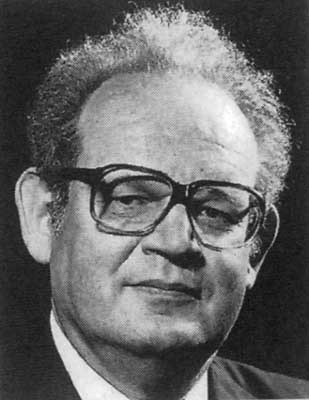
Benoit B. Mandelbrot (1924-2010). The first picture features figures by Gaston Julia who, together with Pierre Fatou, was among the first mathematicians to study iterated functions. Julia discovered a whole new class of strange and beautiful shapes, today called 'Julia sets.' The second picture is of the computer as a concept, or as an extended mind - a Mandelbrot mind in this case. Inside the display frame is one of Mandelbrot's experiments en route to discovering the Mandelbrot set (or M-set). The third picture is the M-set. Mandelbrot discovered the M-set when he was trying to make a map of Julia sets. M-set is defined as: The set of all points C for which the iteration Zt+1 = Zt2 + C, with Z0=0, stays bounded as t → ∞.


Julia sets (1918), p. 18. ● Mandelbrot screen (2004), p. 162. ● Mandelbrot set (or M-set)
Mandelbrot wrote about the discovery of the M-set:
"Not only did I have access to a computer in 1979, but I was familiar with its power. The fact that no one knew what was going to emerge was enough to make these calculations worth trying. A fishing expedition led to a primitive form of [the Mandelbrot-set]." (My bold, B.T.). Lesmoir-Gordon (2004). p. 59.
"To approximate the IFS (iterated function systems or schemes) limit involves an easy mechanical process, and that should be undertaken first. Next, one should inspect pictures of a sufficient number of variants of the IFS limit and check for structures that may be suggested by the eye. A deep thinking mode should come later. Of course, this is precisely the strategy whose best-known success was the discovery, then about to be announced, of the Mandelbrot-set." Mandelbrot (2004), p. 177.
M-set is a virtual entity which lives only in a computer. The computer is an extension of the human mind, creating a new culture - CompuMind. The computer to the mind is more than ships to legs (Columbus) or telescopes to eyes (Kepler). Maybe, one day, we will find that our brain was designed by God when He was playing with M-set.
Julia, (1918). "Memoir on Iterations of Rational Functions." Translated by Alessandro Rosa (2001).
Nigel Lesmoir-Gordon (2004). "The Colours of Infinity: The Beauty and Power of Fractals," including CD. Clear Books.
Mandelbrot (2004). "Fractals and Chaos." Springer.
http://www.math.yale.edu/mandelbrot/links_sites.html
MA1: Tamari - The Cylinder and the Stock Market. Added January 2000.

Ben Tamari (b. 1942) The speculative index of stock markets behaves like water flowing through a cylinder (sleeve, pipe). Assumption: The mathematical root of speculative stock markets is the “cylinder model” (see Ben Tamari (1990). Foundations of Economics (Hebrew), p. 47, Fig. 3 and Stocks).


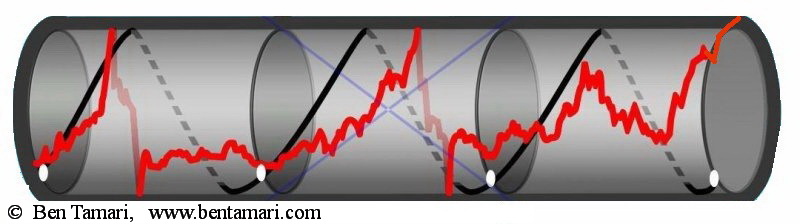
The Cylinder ● The speculative index of the Tel-Aviv Stock Market (1980-2007) ● The Cylinder model for the stock markets.
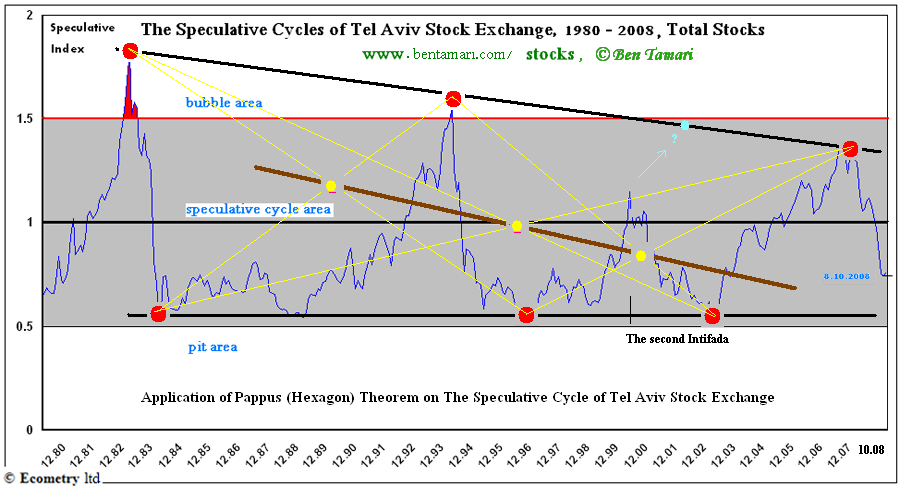
Hypothesis: The mathematical foundations of speculative stock markets are Pappus' Theorem (or Pascal's Theorem) and Desargues' Theorem:

Pappus' Theorem. Weisstein, E. "Pappus's Hexagon Theorem."
Application of the Pappus (Hexagon) Theorem on the speculative cycles of the Tel Aviv Stock Exchange.
N
 Clifford
A. Pickover joke. Added 1 March 2015.
Clifford
A. Pickover joke. Added 1 March 2015.

Note 1, 04 October 2005 Note on the psychology of invention
Hadamard, J. (1945). "The Psychology of Invention in the Mathematical Field." Dover, p. 142.
A letter from Albert Einstein (My bold, B.T.)

Note 2, 25 March 2006 Note on metaphors
Lakoff and Johnson (1980). "Metaphors We Live By." The University of Chicago Press.
"The essence of metaphor is understanding and experiencing one kind of thing in terms of another." p. 5.
"We claim that most of our normal conceptual system is metaphorically structured; that is, most concepts are partially understood in terms of other concepts. This raises an important question about the grounding of our conceptual system. Are there any concepts at all that are understood directly, without metaphor? If not, how can we understand anything at all?" p. 56.
"The reason we have focused so much on metaphor is that it unites reason and imagination." p. 193.
"The natural question to ask, then, is whether people actually think and act in terms of consistent sets of metaphors. A special case where they do is in the formulation of scientific theories, say, in biology, psychology, or linguistics. Formal scientific theories are attempts to consistently extend a set of ontological and structural metaphors." p. 220.
"New metaphors are capable of creating new understandings and, therefore, new realities." p. 235.
"But metaphor is not merely a matter of language. It is a matter of conceptual structure." p. 235.
"... what stands out most in our minds are the metaphors themselves and the insights they have given us into our own daily experiences." p. 239.
It is my hope that my arguments (accompanied by examples) support Lakoff and Johnson's arguments. I have used the term 'metaphor' in a more generalized way, that is, as a kind of an 'image,' 'picture,' 'vision' or 'megametaphor.' From my point of view, the pictures in my mind's eye appeared first, followed by their symbols - letters, words, numbers, and other symbols or signs. Metaphors are not only "conceptual structures," but also mini-images (in our mind) taken from reality. See also Note 2 in Dreams .
In the words of Marcel Danesi (2004). "Poetic Logic: The Role of Metaphor in Thought, Language, and Culture." Atwood Pub, p. 97:
...Metaphor is evidence of the human ability to visualize the universe as a coherent organism. Proof of our capacity, not just to see one thing in another but to change the very nature of things. When a metaphor is accepted as fact, it enters groupthink, taking on an existence in the real world."
Books
Koestler, A. (1964). "The Act of Creation." Pan Books Ltd.
José Ortega and Y. Gasset (1925). "The Dehumanization of Art." Trans. by Helene Weyl, 2nd ed. Princeton.
Lakoff, and Johnson (1980). "Metaphors We Live By." University of Chicago Press.
Merton and Barber (2004). "The Travel and Adventures of Serendipity." Princeton University Press.
Ruelle, D. (2007). "The Mathematician's Brain." Princeton University Press.
Danesi, M. (2004). "Poetic Logic: The Role of Metaphor in Thought, Language, and Culture." Atwood Pub.
Manin, U.I. (2007). "Mathematics as Metaphor: Selected Essays." American Mathematical Society.
Ortony, A. (Ed.) (1993). "Metaphor and Thought." Cambridge University Press.
Rucker, R. (1987). "Mind Tools: The Five Levels of Mathematical Reality." Houghton Mifflin Company, Boston. p. 247.
Links
http://www.britannica.com/EBchecked/topic/377872/metaphor
http://en.wikipedia.org/wiki/Metaphor
http://mason.gmu.edu/~montecin/metasites.htm
Ramachandran V. S. and Hubbard E. M. (2003). "Hearing Colors, Tasting Shapes," Synesthesia and Metaphors, Scientific American.
